

Targeted chiropractic care restores proper spinal alignment and eliminates upper back pain.
That persistent, nagging gnaw between your shoulder blades, often called interscapular or scapular pain, can quietly hijack your daily life. Whether it manifests as a dull ache after four hours at a computer terminal or a sharp, sudden catch every time you take a full breath, upper back discomfort is an increasingly common complaint in our tech-focused culture.
When home remedies like heating pads or over-the-counter painkillers stop providing lasting comfort, seeking specialised care becomes essential. Comprehensive, non-invasive shoulder blade pain treatment in Etobicoke offers a direct pathway toward resolving the underlying structural causes rather than merely masking symptoms.
At Etobicoke Chiro, we focus on identifying the precise biomechanical triggers of upper back discomfort, restoring proper alignment, and keeping you active and pain-free.
Finding the Root Causes of Shoulder Blade Pain
The shoulder blade (scapula) serves as an intricate mechanical bridge connecting your arm, neck, and upper spine. More than 15 separate muscles attach directly to or surround the scapula, working in fine-tuned harmony to facilitate reaching, pulling, and rotating movements. Because of this complex interconnectedness, shoulder blade discomfort can stem from local tissue strain, spinal dysfunction, or even referred signals from internal organs.
To find effective shoulder blade pain treatment in Etobicoke, understanding where the pain originates is the first crucial step.
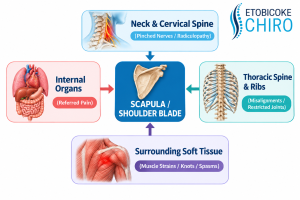
Common Musculoskeletal Causes
- Muscle Strain and Overuse
Overstretching or micro-tearing key upper back muscles, such as the rhomboids, levator scapulae, or trapezius, is one of the most frequent sources of pain. This often occurs due to improper lifting technique at the gym, repetitive overhead motions in sports like swimming or tennis, or carrying heavy bags over a single shoulder. - Poor Posture (The “Tech Neck” Effect)
Hunching over laptops, slouched sitting, and forward head posture force the muscles between the shoulder blades into a state of chronic elongation and strain. Over time, this abnormal traction leads to muscle fatigue, ischemic trigger points (painful knots), and spinal joint restriction. - Scapular Dyskinesis
This condition refers to abnormal positioning or movement patterns of the shoulder blade during arm elevation. Often caused by muscular imbalances or nerve irritation, it can result in a visible “winged” scapula, accompanied by popping, snapping, or clicking sounds during shoulder movement. - Rotator Cuff Tears
Although the rotator cuff sits primarily at the glenohumeral joint (the main ball-and-socket shoulder joint), partial or full tears in these tendons frequently refer sharp or aching pain back into the surrounding scapular region.
Spine and Nerve Issues
- Cervical Radiculopathy – A pinched or inflamed nerve root in the lower neck (most commonly C5, C6, or C7) often sends sharp, burning, or electric-like pain radiating directly into the inner border of the shoulder blade.
- Thoracic Spine Stiffness or Disc Issues – The upper back (thoracic spine) is designed for stability. When thoracic vertebrae experience disc degeneration, bulging, or joint lock, localised or referred pain settles right beneath or around the blade.
- Thoracic Outlet Syndrome (TOS) – Compression of the neurovascular bundle (nerves and blood vessels) between the collarbone and the first rib can trigger pain, tingling, and heavy sensations spanning from the neck down through the upper back and arm.
Referred Internal Medical Conditions
Sometimes, discomfort surrounding the shoulder blades is not a muscle or joint issue at all, but rather a warning sign from internal organs sharing neural pathways with the upper back:
- Gallbladder or Liver Issues – Inflammation of the gallbladder (cholecystitis) or gallstones notoriously causes referred pain beneath the right shoulder blade, often spiking after fatty meals.
- Pancreatitis – Inflammation of the pancreas frequently presents as severe, deep pain underneath the left shoulder blade or penetrating directly through to the back.
- Heart or Lung Conditions – Medical emergencies such as myocardial infarction (heart attack), pulmonary embolism (a blood clot in the lungs), or severe gastroesophageal reflux (GERD) can manifest as intense chest and scapular discomfort.
How Chiropractic Care Relieves Shoulder Blade Pain
Chiropractic care addresses upper back pain at its core by addressing structural misalignments, releasing restricted soft tissues, and restoring normal biomechanical function. Rather than relying on temporary pharmaceutical fixes, a skilled shoulder pain chiropractor in Etobicoke utilises targeted, evidence-based therapies to promote long-term healing.
Comprehensive Chiropractic Assessment
| Core Focus Area | Primary Techniques & Treatments | Key Clinical Goals |
| Joint Realignment | Spinal Adjustments
Rib Manipulations |
Restores proper joint mechanics, reduces nerve irritation, and frees restricted thoracic/costal joints. |
| Soft Tissue Therapy | Myofascial Release
Trigger Point Work |
Relaxes muscle spasms, breaks down fibrotic adhesions, and improves localised circulation around the scapula. |
| Rehabilitation | Postural Retraining
Strengthening Drills |
Rebalances upper body musculature, stabilises the scapula, and prevents long-term pain recurrence. |
1. Spinal and Rib Adjustments
The thoracic spine is connected directly to twelve pairs of ribs. When a thoracic vertebra or rib head shifts slightly out of its optimal position or becomes restricted (“subluxated”), it creates severe localised mechanical strain. This joint restriction traps local nerve endings and triggers reflexive muscle spasms in the surrounding tissue.
By applying precise, controlled force to these restricted areas, a procedure known as Thoracic Manipulation in Etobicoke, chiropractors instantly free stuck joints, reduce neural pressure, and allow the surrounding musculature to relax.
Research published in the Journal of Manipulative and Physiological Therapeutics highlights that high-velocity, low-amplitude thoracic spinal manipulation yields immediate reductions in upper back and shoulder pain while significantly expanding functional range of motion.
2. Targeted Soft Tissue Therapy
Joint realignments work hand-in-hand with soft tissue restoration. Chiropractors incorporate techniques like active myofascial release, instrument-assisted soft tissue mobilisation (IASTM), and deep trigger-point therapy. These methods:
- Break down fibrotic scar tissue from chronic overuse.
- Increase localised microcirculation, bringing oxygenated blood to healing tissues.
- Instantly decrease muscle hypertonicity (spasms) around the scapular borders.
3. Corrective Exercises and Rehabilitation
Realigning joints is only half the battle; keeping them aligned requires balanced muscular support. A comprehensive chiropractic program incorporates active rehabilitation aimed at strengthening weak posterior chain muscles (such as the lower trapezius and rhomboids) while lengthening tight anterior chest muscles (pectoralis major/minor).
A clinical review featured in the Journal of Orthopaedic & Sports Physical Therapy demonstrated that combining manual joint therapy with targeted scapular stabilisation exercises produces vastly superior long-term functional recovery compared to passive therapies alone (JOSPT Review).
Evidence-Based At-Home Relief Strategies
While professional treatment provides definitive resolution, incorporating daily active recovery at home accelerates healing and prevents recurrence.
| Strategy | Primary Mechanism | Recommended Frequency | Key Benefit |
| Shoulder Squeezes | Activates rhomboids & mid-trapezius | 3 sets of 10-12 holds daily | Counters forward head posture |
| Foam Rolling | Thoracic extension & myofascial release | 5–10 minutes per session | Loosens tight thoracic paraspinals |
| Warm Compress | Promotes vasodilation & tissue elasticity | 15–20 minutes as needed | Soothes active muscle spasms |
- Shoulder Blade Squeezes (Scapular Retraction) – Sit upright with your shoulders relaxed. Draw your shoulder blades back and together, as if trying to squeeze a pencil between them. Hold firmly for 3 to 5 seconds, then release. This simple drill wakes up dormant postural muscles.
- Foam Rolling the Upper Back – Lie back on a foam roller positioned perpendicular to your spine beneath your shoulder blades. Support your head with your hands and gently roll up and down from the mid-back to the top of the shoulders (avoiding the neck and lower back). This opens up restricted thoracic joints and hydrates tight fascia.
- Warm Compress Application – Applying moist heat to cramped upper back muscles for 15 to 20 minutes enhances localised blood flow, flushes out inflammatory metabolic waste, and prepares tight tissues for stretching.
When to See a Chiropractor
Knowing when to seek professional intervention ensures you get the right care before minor joint restrictions evolve into chronic conditions. You should schedule an evaluation for shoulder blade pain treatment Etobicoke if you notice any of the following:
- Persistent Discomfort – The ache or stiffness between or under your shoulder blades lasts for more than a few days and shows no improvement despite adequate rest, heat, or stretching.
- Pain Triggered by Posture or Specific Movement – Discomfort consistently flares up after extended hours working at your desk, or intensifies during specific actions like turning your torso, reaching overhead, or lifting objects.
- Limited Range of Motion – You feel a distinct “locked” or “stuck” sensation in your upper spine or shoulder, making it difficult to turn your head smoothly, roll your shoulders back, or comfortably reach behind your waist.
- Rib Pain When Breathing – You experience a sharp, localised catch near your shoulder blade every time you take a deep breath. This sharp inhalation pain frequently signals a minor costovertebral (rib) joint misalignment.
- Radiating Nerve Sensations – You experience shooting pain, mild tingling, or pins-and-needles sensations that travel from your neck downward into your shoulder blade or down the arm.
Customised care plans incorporating shoulder pain relief treatments ensure that your unique mechanical bottlenecks are systematically addressed.
Red Flag Symptoms – When to Seek Immediate Emergency Care
Not all upper back pain is a musculoskeletal issue suitable for chiropractic intervention. Certain symptoms indicate potentially life-threatening medical emergencies that require immediate emergency evaluation.
Do NOT visit a chiropractor; instead, call emergency services (911) or go to the nearest emergency department immediately if your shoulder blade pain is accompanied by:
- Chest pain, tightness, pressure, shortness of breath, dizziness, cold sweats, or nausea.
- Pain radiating directly into your jaw, neck, throat, or left arm.
- Sudden, severe muscle weakness in your arm or a complete loss of grip strength.
- High fever, unexplained weight loss, night sweats, or pain that worsens dramatically when lying completely flat at night.
- Severe physical trauma occurring immediately after a motor vehicle accident, major fall, or direct high-impact force to the spine.
Take the First Step Toward Lasting Upper Back Relief
Shoulder blade pain does not have to be an accepted drawback of working at a desk or living an active lifestyle. By combining targeted spinal realignments, advanced soft tissue techniques, and evidence-based corrective exercises, chiropractic care provides an effective path toward sustainable recovery.
If persistent upper back pain is limiting your mobility, productivity, or sleep, professional care can help you regain your quality of life. Explore specialised shoulder blade pain treatment in Etobicoke today and contact Etobicoke Chiro to restore your body’s natural movement and function.




