

Evidence-based sports chiropractic care and functional rehab to keep Etobicoke athletes moving.
Whether you are training for a half-marathon along the Humber River trails, playing competitive hockey at Centennial Park Arena, or fitting in a weekend round of golf, physical activity is a vital component of life in West Toronto.
However, pushing your body to achieve peak performance often comes with physical demands. When strains, sprains, or joint restrictions strike, finding an experienced sports injury chiropractor Etobicoke athletes trust can mean the difference between weeks on the sidelines and a swift, full recovery.
Modern sports chiropractic care has evolved far beyond basic spinal alignment. Today’s practitioners evaluate the full kinetic chain: how your ankle affects your knee, how your hip influences your low back, and how movement mechanics across your entire body dictate performance and injury risk.
Why Etobicoke Athletes Face Unique Musculoskeletal Demands
Etobicoke boasts a vibrant community of active individuals, ranging from youth league soccer players to adult marathoners and recreational tennis players. However, local athletic habits combined with urban lifestyle factors create distinct stress patterns on the body.
Many active residents balance demanding athletic schedules with long, sedentary desk hours or extended highway commutes into downtown Toronto. This transition from prolonged sitting to explosive athletic output places extreme stress on tight hip flexors, weak gluteal muscles, and a rigid thoracic spine.
When you suddenly jump into a weekend sport with underlying postural imbalances, your risk of both acute micro-trauma and chronic overuse injuries spikes dramatically. Working with an expert in sports injury chiropractic care allows athletes to address these underlying imbalances before they turn into full-blown physical setbacks.
Common Sports Injuries Treated in Etobicoke
Local healthcare clinics across Etobicoke routinely see sports injuries falling into two main categories: acute traumatic injuries caused by sudden force or direction changes, and repetitive strain injuries resulting from cumulative overuse.
1. Running & Field Sport Conditions
Etobicoke’s extensive network of paved waterfront paths, community parks, and turf fields sees heavy foot traffic year-round.
- Runner’s Knee & Patellofemoral Pain Syndrome (PFPS) – Overuse knee pain characterised by a dull ache under or around the kneecap. It is frequently aggravated by running on hard or uneven outdoor surfaces and is often tied to poor hip stability or abnormal foot pronation.
- Shin Splints & Achilles Tendinopathy – Lower leg inflammation common among runners who rapidly increase their weekly mileage on concrete pathways. According to research published in the Journal of Athletic Training, improper training loads combined with foot mechanics account for over 35% of lower extremity overuse injuries in runners.
- Ankle Sprains & ACL Tears – Common acute traumas caused by sudden twists, pivots, or slips on trail terrain or during soccer, rugby, and football matches.
- Hamstring & Groin Strains – Pulled or micro-torn muscle fibres resulting from explosive sprinting, acceleration, or sudden decelerations.
2. Overhead, Racquet, & Ice Sport Strain
Repetitive swinging, throwing, and upper-body loading motions from sports like tennis, baseball, swimming, and hockey frequently lead to upper-body compensation patterns.
- Rotator Cuff Strains & Shoulder Impingement – Gradual wear or acute micro-tears in the shoulder stabiliser muscles, restricting overhead arm mobility and causing sharp pain during activity.
- Tennis Elbow & Golfer’s Elbow (Lateral/Medial Epicondylitis) – Tendon irritation around the elbow joint caused by repetitive wrist extension or wrist flexor loading. A sports injury chiropractor in Etobicoke patients visit regularly, notes that this condition affects not only “weekend warriors” on the court, but also desk workers who type on non-ergonomic setups all day.
3. Rotational Torque & Impact Conditions
- Lower Back & Hip Strains – Caused by the high rotational torque required during golf swings, baseball bats, or hockey slapshots. These forces are often amplified when an athlete has stiff hips or a rigid mid-back.
- Concussions & Whiplash Dynamics – Head and neck injuries caused by rapid acceleration/deceleration forces or direct impact. Comprehensive management includes cervical spine rehab, vestibular tracking, and soft tissue release around the neck.
How Sports Chiropractors Treat the Full Kinetic Chain
A common myth is that chiropractors only perform spinal adjustments. While spinal health is foundational, a qualified clinic like Etobicoke Chiro approaches your body as an integrated functional unit, treating joints, muscles, tendons, fascia, and nervous system pathways together.
The Kinetic Chain Approach |
|
| Body Region / Mechanism | Target Biomechanical Effect |
| Lumbar & Pelvic Alignment | Restores core torque transmission |
| Hip Mobility & Glute Drive | Reduces knee strain & collapse |
| Ankle/Foot Mechanics | Normalises impact forces |
Advanced Non-Spinal & Soft Tissue Therapies
Instead of relying solely on spinal adjustments, modern practitioners utilise multi-modal therapies tailored to your specific phase of recovery:
- Joint Mobilisation & Manipulation – Applying precise, controlled force or low-velocity mobilisations to restricted peripheral joints (shoulders, elbows, knees, ankles) to restore natural joint sliding and glides.
- Instrument-Assisted Soft Tissue Mobilisation (IASTM) – Utilising specialised ergonomic tools (such as Graston technique instruments) to detect and break down chronic scar tissue, fascial adhesions, and tendon fibrotic buildup.
- Active Release Technique (ART) – A hands-on, movement-based soft tissue system that treats problems with muscles, tendons, ligaments, fascia, and nerves by placing the tissue under tension while moving the patient through a specific range of motion.
- Targeted General Chiropractic Treatment – Realigning spinal segments to optimise nerve transmission, clear joint restrictions, and relieve compensatory stress on nearby muscle groups.
- Neuromuscular Re-Education – Retraining faulty motor patterns using functional movement screening so your body stops relying on compensation strategies during competition.
What the Research Says About Chiropractic for Athletes
Clinical evidence strongly supports integrating chiropractic care into an athlete’s recovery routine.
| Reduced Injury Incidence
A study published in the BMC Musculoskeletal Disorders journal demonstrated that sports chiropractic care combined with targeted soft tissue therapy reduced lower limb muscular injuries in professional athletes by up to 30% compared to standard medical care alone.’ |
| Enhanced Sensorimotor Control
Research in the Journal of Manipulative and Physiological Therapeutics highlights that joint mobilisation directly influences central nervous system processing, improving joint position sense (proprioception) and reducing muscle reaction times after an injury. |
By combining evidence-based manual therapy with progressive exercise prescription, a skilled sport injury chiropractor in Etobicoke athlete partner accelerates recovery while lowering the risk of re-injury.
Step-by-Step Chiropractic Treatment Journey
If you are visiting Etobicoke Chiro for the first time following a sports injury, here is what you can expect throughout your recovery roadmap:
| Phase | Clinical Objective | Primary Modalities & Interventions |
| 1. Comprehensive Assessment | Identify root cause, rule out red flags, map kinetic chain | Range of motion tests, orthopaedic testing, gait analysis, movement screening |
| 2. Acute Relief & Deinflammation | Calm acute pain, reduce oedema, protect healing tissue | Light joint mobilisation, ice/cryotherapy, gentle soft tissue work, kinesiology taping |
| 3. Joint Mobility & Alignment | Restore joint mechanics, reduce spinal/peripheral restrictions | Targeted general chiropractic treatment, high-velocity low-amplitude (HVLA) thrusts, joint glides |
| 4. Soft Tissue & Scar Work | Break up adhesions, lengthen shortened muscles | Active Release Technique (ART), IASTM (Graston), trigger point therapy |
| 5. Active Rehab & Prevention | Rebuild strength, enhance proprioception, prevent relapse | Sport-specific functional exercises, balance training, home mobility programs |
What Happens During Your Initial Evaluation?
During your initial consultation, your chiropractor will take a deep dive into how your injury occurred, your current training volume, footwear choices, and underlying movement mechanics. You will go through active range-of-motion assessments, strength tests, and specialized orthopedic maneuvers.
If necessary, your chiropractor may request diagnostic imaging (X-rays or MRI) or coordinate with your broader healthcare team to ensure a safe, precise diagnosis before starting hands-on therapy.
Preventive Care & Performance Optimisation
You don’t need to be currently injured to benefit from seeing a sport injury chiropractor Etobicoke sports community members rely on. Many local athletes use preventative chiropractic maintenance as a proactive strategy to boost performance and prevent injuries before they happen.
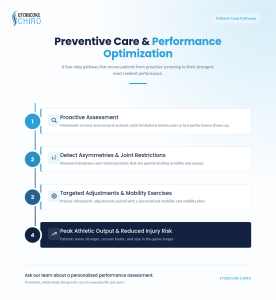
Proactive chiropractic care offers several key performance benefits:
- Improved Joint Range of Motion – Removing joint restrictions allows hips, shoulders, and ankles to move through their full, natural range, delivering maximum leverage during swings, strides, or throws.
- Enhanced Muscle Activation – Nerve root compression or joint dysfunction can inhibit muscle signalling. Proper alignment ensures firing patterns are crisp and symmetrical.
- Faster Recovery Between Workouts – Specialised soft tissue work and joint mobilisation speed up post-workout recovery by clearing metabolic waste and relaxing tight muscular structures.
- Customised Ergonomic & Mobility Guidance – Receive tailored advice on home stretching routines, proper footwear selection, and warm-up protocols specific to your sport and body type.
Frequently Asked Questions
Is sports chiropractic treatment safe for acute injuries?
Yes. When performed by a qualified, licensed practitioner, sports chiropractic care is extremely safe. During acute stages of an injury, your chiropractor will avoid aggressive force, utilising gentle soft tissue release, light joint glides, and cryotherapy to calm inflammation before progressing to deeper care.
How does chiropractic care differ from traditional physiotherapy?
While both disciplines treat sports injuries and share overlap in exercise rehabilitation, chiropractors place a specialised focus on joint mechanics, spinal alignment, and nervous system function alongside soft tissue treatment. Many modern clinics combine both approaches to give athletes the most complete recovery possible.
How many sessions will I need before I can return to my sport?
Recovery timelines depend on the injury severity, your overall health, and how closely you stick to your home rehabilitation program. Mild soft tissue strains may improve significantly within 3 to 6 sessions, while complex conditions like chronic rotator cuff tendinopathy or severe ligament sprains may require 8 to 12 weeks of progressive care.
Get Back to Doing What You Love
Injuries don’t have to keep you off the field, trail, or court for months on end. By addressing both the symptoms and the root biomechanical causes of your pain, specialised sports injury chiropractic care provides a clear pathway back to peak performance.
If you are dealing with a fresh injury or a nagging ache that won’t go away, booking a consultation with an experienced sports injury chiropractor in Etobicoke team can help you move better, recover faster, and protect your body for years of active living.




