

A step-by-step guide to building clear medical evidence for personal injury claims in Ontario.
Sustaining an injury in a motor vehicle accident or a slip-and-fall incident can disrupt your daily routine, interfere with your ability to work, and cause severe physical discomfort. When pursuing financial compensation through a personal injury claim, your medical recovery and your legal case become closely linked. In Ontario’s personal injury landscape, thorough and precise medical evidence serves as the foundation of any successful insurance settlement or legal action.
For residents seeking care following an accident, consulting an experienced personal injury chiropractor in Etobicoke ensures that your physical recovery is fully supported by an airtight document trail. Receiving professional treatment is only half of the equation; the quality, accuracy, and detail of your clinical records play a pivotal role in validating your experience to insurance adjusters and legal representatives.
Why Chiropractic Documentation Is the Backbone of Your Personal Injury Claim
Insurance adjusters do not evaluate claims based solely on a patient’s pain reports; they rely on verifiable, objective medical data. Detailed chiropractic documentation establishes a clear legal and medical link between the specific incident and your diagnosed injuries. Without consistent documentation, insurance providers may attempt to classify your symptoms as pre-existing conditions, minimise the severity of your soft-tissue damage, or argue that the treatment was medically unnecessary.
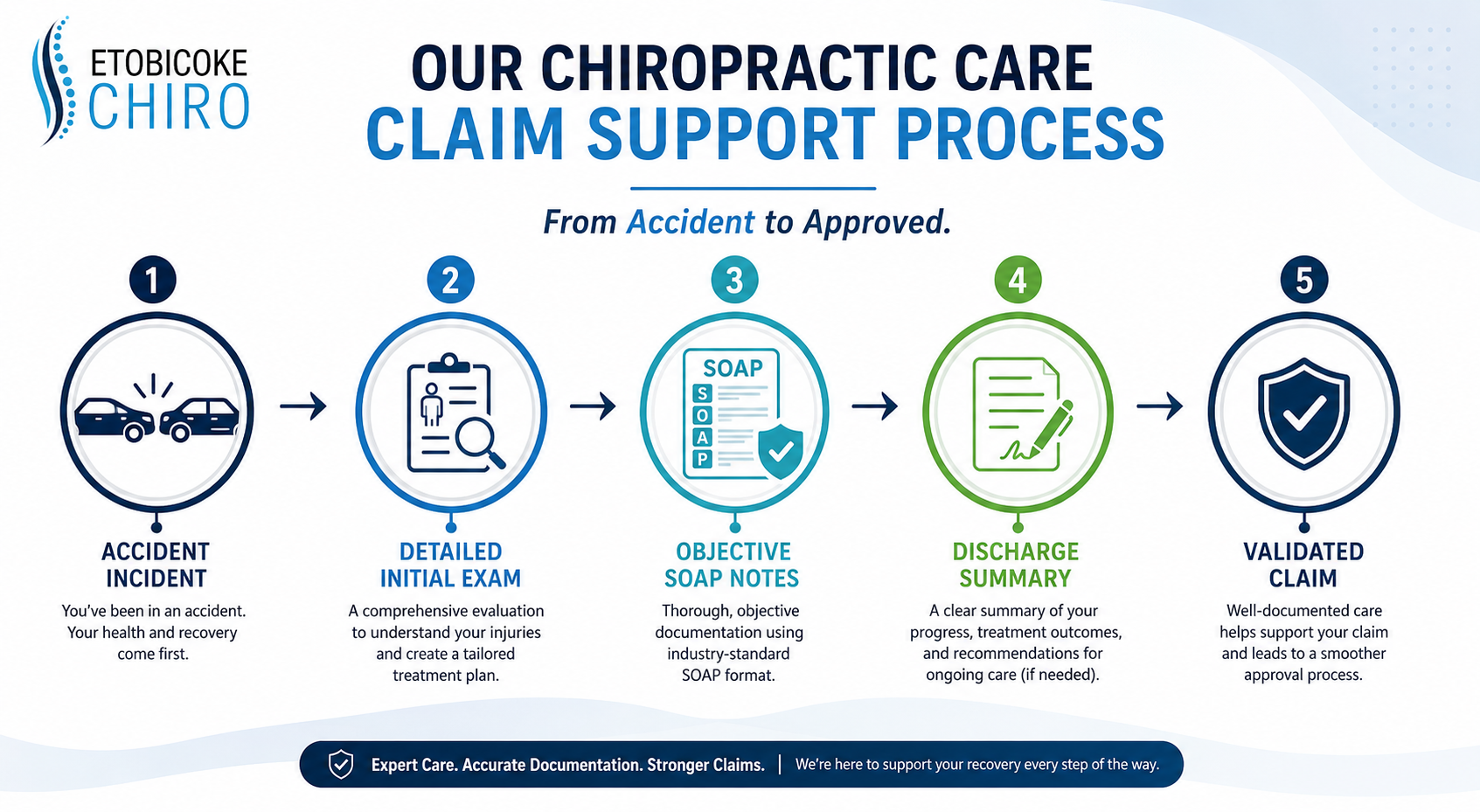
According to clinical research published by the National Center for Biotechnology Information (NCBI), detailed and standardised clinical documentation significantly improves patient outcomes and reduces diagnostic ambiguity in legal and insurance evaluations. When your care team maintains complete records, it eliminates guesswork and provides your personal injury lawyer with the evidence needed to negotiate fair compensation.
To ensure your case remains strong, your clinical file must feature several essential components:
- Direct Causation – Proof that the accident directly caused the musculoskeletal trauma.
- Objective Measurement – Quantifiable tracking of physical limitations rather than subjective impressions.
- Medical Necessity – Documentation explaining why active clinical care is required to restore normal function.
- Consistency – An unbroken timeline showing regular attendance and ongoing evaluation.
The Core Components of an Airtight Chiropractic Record
When preparing injury claim documentation in Etobicoke, every stage of your care must be recorded with clinical precision. High-quality records transform your subjective physical pain into undeniable, legally admissible facts.
Core Components Of Chiropractic Records |
||
|---|---|---|
| # | Core Component | Key Focus & Clinical Details |
| 1 | Initial Intake & Accident History | Exact accident mechanics (impact direction, speed, surface conditions), immediate vs. delayed symptom onset, and pre-existing health baselines. |
| 2 | Objective Examination & Measurable Data | Quantifiable metrics including Range of Motion (ROM) in degrees, standardised orthopaedic/neurological tests, and manual muscle testing grades (0–5). |
| 3 | Standardised SOAP Progress Notes | Per-visit chronological tracking using Subjective pain ratings (0–10 NPRS), Objective clinical findings, Assessment updates, and specific Plan interventions. |
| 4 | Documented Medical Necessity | Clinical evidence justifying why active chiropractic care and rehabilitation are required to restore function rather than general wellness care. |
| 5 | Functional Impact on Daily Living (ADLs) | Documenting specific restrictions on occupational duties, domestic tasks, personal hygiene, and sleep quality. |
1. Initial Intake & Comprehensive History
Your first appointment sets the baseline for your entire claim. Your chiropractor must record the precise mechanics of the accident alongside your immediate physical response.
- Accident Mechanics – For motor vehicle accidents, this includes impact direction (rear-end, side-impact, head-on), vehicle speed, seatbelt use, headrest position, and whether airbag deployment occurred. For slip-and-fall cases, it includes surface conditions, footwear, and the point of physical impact.
- Symptom Onset – Exact timing of when pain, stiffness, headaches, or numbness began. Immediate onset often indicates acute structural trauma, whereas delayed onset (24 to 72 hours later) is common in soft-tissue whiplash injuries.
- Pre-Existing Baseline – A transparent review of your physical health prior to the incident to demonstrate that your current symptoms are new or represent a distinct aggravation of a prior condition.
2. Objective Examination & Measurable Metrics
Vague statements like “patient reports feeling sore” hold little weight with insurance claims managers. Strong documentation relies on objective clinical findings:
- Range of Motion (ROM) – Precise degree measurements of spinal flexibility using goniometers or inclinometers (e.g., “Cervical flexion restricted to 25° out of a normal 50° with sharp terminal pain”).
- Orthopaedic & Neurological Testing – Standardised tests, such as Spurling’s test for nerve root compression, Straight Leg Raise for lumbar disc involvement, or deep tendon reflex assessments.
- Palpation & Muscle Testing – Palpable muscle spasms, localised oedema, trigger points, and manual muscle testing graded on a standardised 0–5 scale.
3. Standardised SOAP Notes
The SOAP format is the international gold standard for clinical record-keeping. Every visit to your Etobicoke clinic must generate a corresponding SOAP note:
- S (Subjective) – Patient’s current self-reported pain levels using a 0–10 Numerical Pain Rating Scale (NPRS) and functional feedback regarding daily tasks.
- O (Objective) – The chiropractor’s visual inspection, physical palpation findings, segment mobility checks, and functional movement observations during that specific session.
- A (Assessment) – Clinical evaluation of progress, response to the previous treatment session, and diagnosis updates.
- P (Plan) – Specific therapeutic interventions performed (e.g., spinal manipulative therapy, soft tissue release, spinal decompression) and the prescribed home rehabilitation exercises.
4. Demonstrating Medical Necessity
To secure coverage under Ontario’s Statutory Accident Benefits Schedule (SABS) or private extended health plans, care must be medically necessary. Documentation must explain how adjustments, soft-tissue therapy, or active rehab address specific functional deficits rather than general lifestyle wellness.
Data from the Canadian Chiropractic Association (CCA) highlights that structured, evidence-informed chiropractic management after soft-tissue injuries accelerates return-to-work timelines and mitigates the risk of chronic disability. Clear documentation links clinical treatments directly to functional recovery milestones.
5. Tracking Functional Impact (Activities of Daily Living)
Insurance companies measure injury severity by how it impacts your ability to perform everyday duties. Proper injury claim documentation in Etobicoke tracks restrictions in Activities of Daily Living (ADLs):
| Category | Specific Functional Restriction Tracked |
| Occupational | Inability to sit at a desk for more than 20 minutes; restriction against lifting over 10 lbs. |
| Domestic | Difficulty bending to load laundry, vacuuming, or preparing meals due to lumbar pain. |
| Personal Care | Pain during overhead reaching while washing hair or dressing. |
| Rest & Sleep | Frequent night waking caused by cervical inflammation or radicular discomfort. |
Tailoring Documentation to Specific Accident Scenarios
Different accident scenarios involve distinct physical mechanics, regulatory frameworks, and legal standards. Your chiropractic documentation should adapt to reflect these specific circumstances.
Motor Vehicle Accidents (MVAs)
Car crashes subject the spine to rapid acceleration-deceleration forces, often resulting in Whiplash-Associated Disorders (WAD). In Ontario, MVA claims follow strict guidelines established by the Financial Services Regulatory Authority of Ontario (FSRA).
- Minor Injury Guideline (MIG) – Documentation must establish whether your injuries fall inside or outside the $3,500 MIG funding cap. If you suffer from pre-existing conditions, partial-thickness tears, or severe neurological impairment, your chiropractor must document these factors to access extended treatment coverage up to $65,000 under non-catastrophic benefit categories.
- Biomechanical Context – Capturing how seatbelt restraint forces, head restraint alignment, and steering wheel impacts correspond with localised spinal subluxations or ligamentous strain.
Slip and Fall Incidents
Slip-and-fall claims are governed by the Occupiers’ Liability Act. Unlike MVA claims, proving liability requires clear evidence that a specific physical hazard directly caused severe bodily trauma.
- Impact Dynamics – Records must capture point-of-impact trauma (e.g., landing directly on the sacrum, hip, or outstretched hands).
- Acute Traumatic Indicators – Immediate post-fall objective evidence such as localised bruising, acute joint swelling, severe muscle guarding, and sudden gait abnormalities.
Workplace & Occupational Injuries
For workplace injuries managed under the Workplace Safety and Insurance Board (WSIB), working with a qualified WSIB chiropractor in Etobicoke ensures your documentation focuses heavily on job-specific duty modifications and return-to-work capabilities.
- Workplace Ergonomics – Linking spinal restrictions to specific job duties (e.g., repetitive overhead reaching, heavy manual lifting, or prolonged vibration exposure).
- Functional Capacity Evaluations – Detailed summaries detailing safe lifting limits, postural rotation allowances, and required ergonomic modifications.
Managing Timeline Factors – Early vs. Delayed Presentation
The time elapsed between the accident and your initial assessment influences how insurance adjusters review your file. Proper clinical documentation must address these timeline nuances directly.
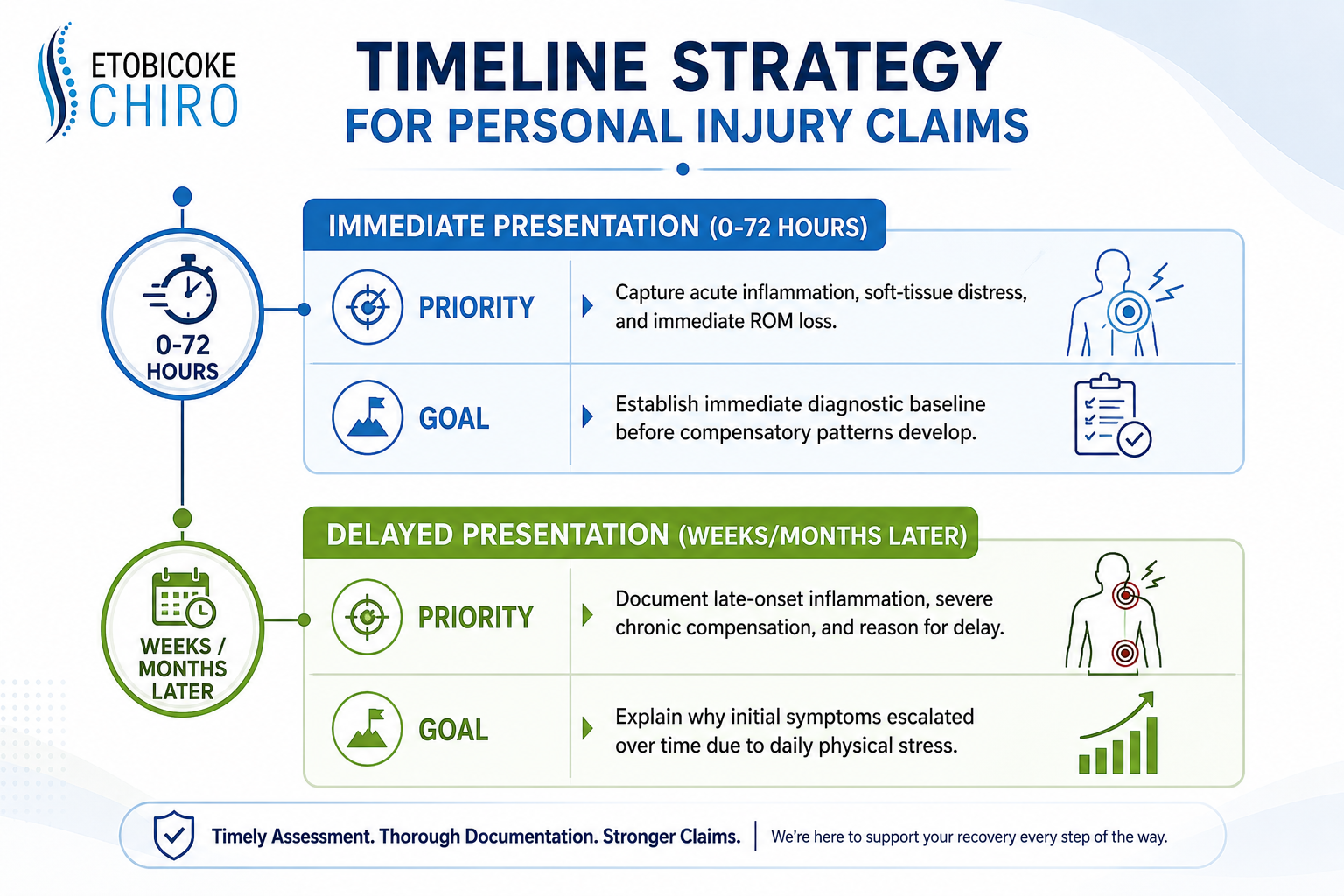
Immediate Assessment (0 to 72 Hours Post-Accident)
Seeking care immediately after an accident provides the clearest baseline for your claim.
- Acute Findings – Capturing immediate post-traumatic inflammation, acute muscle guarding, and drastic restrictions in spinal mobility.
- Preventing Misattribution – Prompt care leaves little room for insurers to claim that an intervening event caused your injuries.
Delayed Assessment (Weeks or Months Post-Accident)
It is common for adrenaline to mask pain immediately after an impact, or for minor micro-tears to gradually develop into severe inflammation over several weeks. If you experience a delay before seeking care, your injury claim documentation in Etobicoke must address this gap directly:
- Documenting the Delay – The clinical record should state clearly why treatment was delayed (e.g., initial expectation that symptoms would resolve independently, delayed onset of radicular numbness, or primary focus on emergency room care for acute lacerations).
- Tracing Secondary Compensation – Documenting how untreated biomechanical imbalances led to secondary compensatory strain patterns in surrounding muscle groups.
Critical Steps for Protecting Your Injury Claim
To protect both your physical recovery and your legal rights, follow these vital guidelines throughout your course of care:
Avoid Gaps in Treatment
Unexplained gaps in your appointment schedule are one of the most common reasons insurance claims are challenged. If you skip scheduled chiropractic visits, insurance adjusters may assert that your injuries have fully healed or that the pain was not severe enough to require professional care. If travel, illness, or work commitments force you to miss an appointment, ensure your clinic logs the valid reason within your file.
Integrate Diagnostic Imaging Reports
While chiropractors evaluate functional mobility and soft-tissue distress through physical exams, structural confirmation strengthens your case. When clinically indicated, your provider will request or review advanced diagnostics:
- X-rays – Identify structural alignment changes, loss of normal cervical lordosis, disc space narrowing, or fractures.
- MRI & CT Scans – Confirm soft-tissue abnormalities such as disc herniations, spinal stenosis, or nerve root impingement.
Your chiropractor’s notes should explicitly reference how these structural findings align with your physical exam metrics and daily symptoms.
Secure a Comprehensive Discharge Summary
Your clinical care concludes with a final discharge summary once you reach Maximum Medical Improvement (MMI), the point at which your condition has stabilised and further significant recovery is unlikely.
This final report is a crucial document for your personal injury claim. It provides a complete summary of your care, including:
- Initial symptoms compared against final objective outcome measurements.
- Overall percentage of functional recovery achieved.
- Documented residual impairments, permanent restrictions, or ongoing care requirements.
- Long-term prognosis and projected future healthcare needs.
Frequently Asked Questions About Personal Injury Chiropractic Claims
1. Do I need a referral from a medical doctor to see a chiropractor after an accident in Ontario?
No, chiropractors in Ontario are primary contact health care professionals, meaning you do not need a medical doctor’s referral to book an assessment or begin treatment. However, if you are claiming treatment costs through an extended health insurance policy, some private insurers may require a physician’s note for reimbursement. For Motor Vehicle Accident (MVA) claims submitted through Ontario’s Statutory Accident Benefits Schedule (SABS), your chiropractor can complete and submit the initial Disability Certificate (OCF-3) directly on your behalf.
2. What is Ontario’s Minor Injury Guideline (MIG), and how does documentation affect it?
The Minor Injury Guideline (MIG) is a regulatory framework under SABS that caps medical and rehabilitation funding at $3,500 for injuries categorised as minor (such as general sprains, strains, or mild whiplash). Detailed chiropractic documentation is critical because if your injuries involve pre-existing conditions, chronic pain development, structural disc damage, or neurological impairment, your chiropractor can submit objective clinical evidence (via an OCF-18 Treatment Plan) to reclassify your claim outside the MIG, unlocking up to $65,000 in non-catastrophic medical benefits.
3. How soon after a car accident or workplace injury should I get documented?
You should seek a clinical evaluation within 24 to 72 hours of the incident. Immediate documentation records acute post-traumatic findings—such as inflammation, muscle guarding, and restricted mobility—before your body develops compensatory motion patterns. Furthermore, under Ontario auto insurance rules, you must notify your insurer within 7 days of the crash and submit your formal accident benefits application (OCF-1) within 30 days.
4. Will my auto insurance or WSIB pay the clinic directly, or do I pay out of pocket?
In most cases involving a Motor Vehicle Accident (MVA) or a Workplace Safety and Insurance Board (WSIB) claim, the clinic bills the insurance provider directly. Under Health Claims for Auto Insurance (HCAI) guidelines in Ontario, approved treatment plans are billed straight to your auto insurer, meaning eligible patients incur $0 out-of-pocket expenses at the desk for covered care.
5. What happens if I have a gap in my chiropractic treatment schedule?
Unexplained gaps in your visit log create significant risk for your personal injury claim. Insurance adjusters routinely interpret missed appointments as evidence that your pain has resolved or that care is no longer medically necessary. If you must miss a session due to illness, work commitments, or personal emergencies, inform your clinic immediately so the specific reason can be officially recorded in your SOAP notes.
6. What key documents will my personal injury lawyer request from my chiropractor?
Your legal team will request a complete copy of your chart, which includes:
- The Initial Assessment & Accident History Report (detailing collision mechanics and acute symptoms).
- Objective Baseline Testing & Diagnostic Imaging Reports (X-rays, MRI interpretations, and goniometric ROM measurements).
- Chronological SOAP Notes (recording attendance, symptom evolution, and treatment response).
- The Final Discharge Summary / MMI Report (outlining maximum medical improvement reached, residual physical impairments, and future care recommendations).
Partnering with an Experienced Chiropractic Team
Navigating an injury claim while recovering from physical trauma can feel overwhelming. Working with a clinic like Etobicoke Chiro ensures that your recovery is guided by evidence-based care while your clinical file meets all legal and regulatory standards.
If you or someone you know has been involved in an accident, securing accurate injury claim documentation in Etobicoke is a critical first step. Professional evaluation ensures your physical health is protected and provides your legal team with the clear documentation required to handle your claim effectively.





